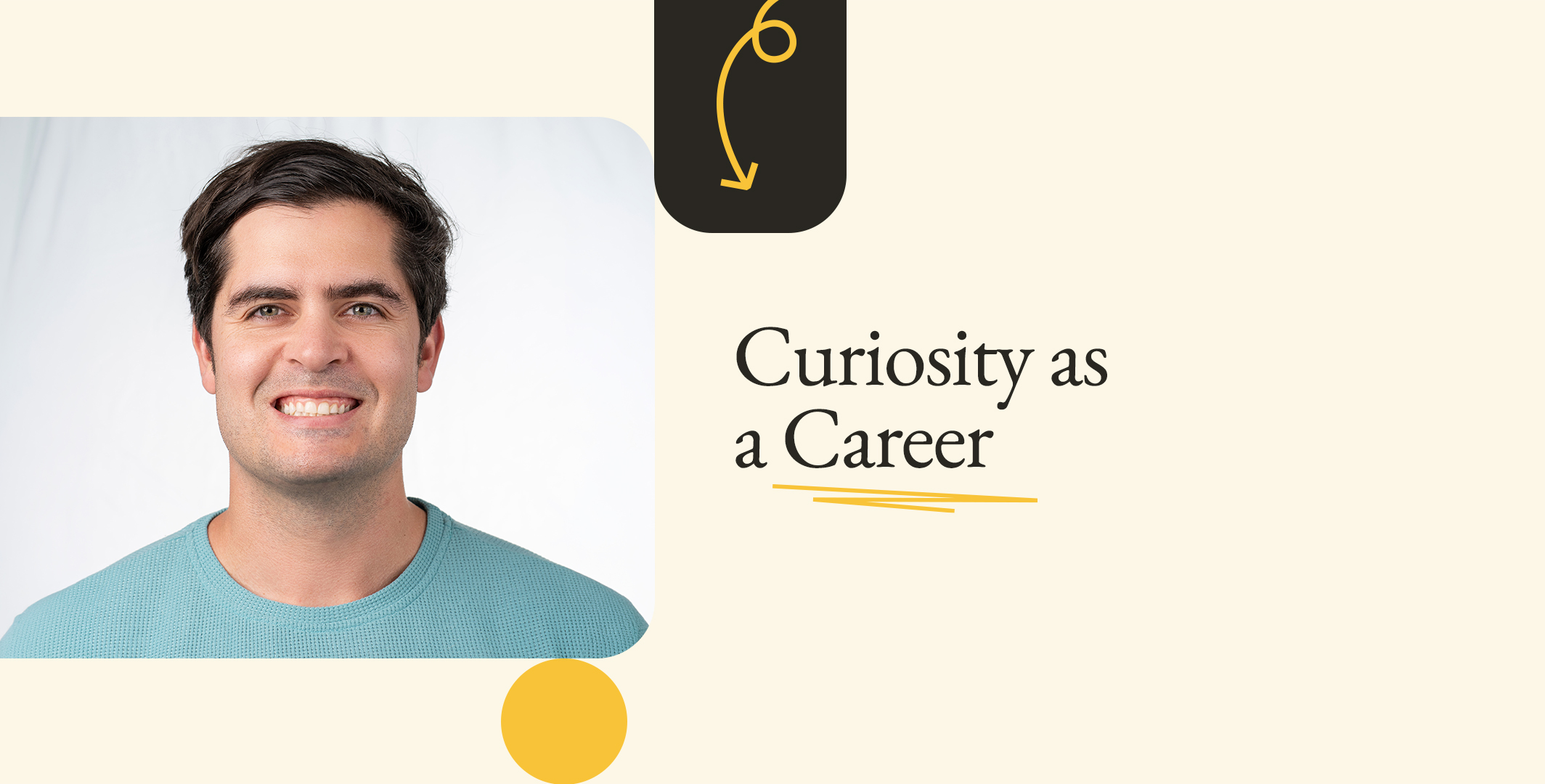
Langley Barth - Curiosity as a Career

We sit down with Langley Barth, product marketer at Intuit, to explore how better customer conversations reduce blind spots, shape smarter decisions, and help teams move before the market moves past them.

Podcast

Listen to the episode below

Episode Recap

Langley Barth brings a clear point of view to product marketing: the job is not just to launch things or tighten up messaging. It’s to understand what customers care about, notice what other teams are missing, and help the business make better decisions with less market risk.

A lot of that comes back to conversation quality. Langley talks about what happens when you stop treating customer calls like a script to get through and start treating them like a chance to learn. The best insights are not usually sitting inside the question guide. They show up when someone goes deep, surfaces an unknown unknown, and gives you something the team can actually work with.

The episode also gets into how Langley is thinking about AI right now. Not as a reason to use every new tool, but as a way to get to speed to first draft, build a better thought partner, and turn repeatable work into systems. The throughline is judgment. Move faster where it helps, stay close to fundamentals, and do not let the work drift into sameness.

01

Customer trust changes the signal

Langley talks about building trust early, finding an uncommon commonality, and making it clear the conversation is not a sales call. That is what gives people room to move past the polished answer and talk more honestly about what is actually happening in their work.

02

The best insights show up off script

He is not chasing perfect interview execution or trying to get through every question on a guide. He is looking for the moment where someone goes down a rabbit hole, surfaces an unknown unknown, and gives the team something they would not have found on their own.

03

Product marketing point guard

Langley describes the role as helping analytics, sales, product, and marketing see the same pattern from different angles and decide whether it is a one-off, a signal, or a real opportunity. The job is not just to gather input. It is to help the right people know what to do with it.

04

AI as thought partner

The strongest use cases he comes back to are speed to first draft, a thought partner that pushes back, and systems for repeatable work that would otherwise eat up time. The value is not in using every tool. It is in using the right ones without letting the work drift into sameness.

05

Balancing the customer and the business

Langley talks about code switching across teams and asking two questions again and again: is this right for the customer, and is this right for the business? Depending on the room, one side may need more emphasis, but the work gets better when both stay in view.

06

Big swing hunting

Langley talks about searching for ideas that have worked somewhere else, pressure-testing how they could fit his own context, and building enough of a business case to give them a real shot. He does not expect most of them to work. The point is that the wins that do land can be big enough to make the misses worth it.

AI and speed to first draft

The conversation opens with what has been occupying Langley’s brain lately, and that turns out to be AI. Not in a broad, future-of-work way. More in the day-to-day sense of what it is actually doing to how people work right now.

Langley describes the current moment like an ocean with crests and pullbacks. People rush in, every tool starts to feel urgent, and then the same thing starts happening across the board. The work flattens out. The language gets familiar. The output starts sounding like it all came from the same place. That is the part he is wary of.

What he wants to keep is narrower and more concrete. He talks about speed to first draft as one of the clearest use cases. If AI can get you to a starting point faster, that matters. He also likes using it as a thought laboratory instead of an echo chamber, somewhere he can get pushback, devil’s advocate energy, and help seeing what he might be missing. Then there is the systems side, where repeatable work becomes something you do not have to rebuild from scratch every time.

That framing matters because it sets up the rest of the episode. Langley is not looking for more noise. He is looking for leverage without losing judgment. The tool can help you move faster, but the human part still has to carry the thinking, the collaboration, and the final call.

Langley’s path into product marketing

Once Garus shifts from AI into Langley’s background, a lot of his later thinking starts to make more sense. Langley talks about coming out of a service academy, spending six years in the Navy, and realizing over time that he wanted a different kind of work and a different kind of life.

He does not describe that transition like a leap. He describes it like something he worked through carefully. He had a lot of conversations, logged what he was learning, and thought about the next move in terms of trade-offs. What kind of work felt proactive instead of reactive. What kind of role left room for creativity. What kind of path could still feel structured without closing off the rest of his life.

When Langley talks about getting up to speed at Intuit, he also points to the kind of support that helped him ramp. He mentions his mentor named Angela Torrey-Dohenyela, who pushed him to sequence the work instead of trying to solve everything at once: focus on the product first, keep learning, and get close to customers early. That advice gave him a way into a technical space without pretending he had to understand all of it on day one.

That is where product marketing started to make sense. It gave him a role that sat across functions, stayed close to real decisions, and still had room for curiosity, creativity, and strategic thinking. It also gave him a place where the habits he had built earlier, around planning, trade-offs, and adapting to the situation in front of him, would still matter.

So by the time the conversation gets deeper into product marketing, you already have the context for how he sees the role. He is not describing an abstract PMM job. He is describing a kind of work that fit the way he already thinks.

Trade-offs and reducing blind spots

From there, the conversation moves into what product marketing looks like when you are sitting between different teams with different incentives. That is where Langley starts talking about code switching.

He describes situations where product, engineering, and design are deeply anchored in customer problems, and his role is to ask what all of that means for the business. Then he describes other rooms where sales, marketing, or support are further from the product or the customer, and his role is to pull the conversation back toward what users are actually dealing with. Same person. Different emphasis. Same bigger job.

That is where the blind-spot idea starts to take shape. For Langley, product marketing is not only about launches or messaging. It is also about making sure a team does not get trapped inside one partial view of the problem. If everyone is overindexing on current users, someone needs to ask what the broader market looks like. If the business conversation is running too far ahead of the customer, someone needs to pull it back.

So when he talks about reducing blind spots, it is not vague. He means helping teams notice what they are not seeing yet, and making better decisions before those gaps turn into bigger problems.

Customer conversations, uncommon commonality and unknown unknowns

Once that idea is on the table, Garus pushes into how Langley actually gets there in practice. That leads into one of the most detailed parts of the episode: how he runs customer and prospect conversations.

Langley spends a lot of time on the front end of the call. He looks for what he calls an uncommon commonality, some real point of connection that lowers the guard a little and makes the conversation feel less transactional. He also makes it clear that he is not there to sell. That matters because he is trying to get the person out of the posture they would use with sales and into something more open.

He also talks about using a few early quantitative questions to place someone into a kind of soft box. That gives him enough context to understand who they are, what kind of firm or workflow they are sitting inside, and how that conversation relates to the others he has been having. Once that frame is there, he can hear more clearly when something does not line up with the expected pattern.

That is where the real learning starts. Langley is not trying to win by getting through every question on the guide. He is trying to create enough space for someone to go deep, go off script, and surface something the team has not named yet. Those are the moments he describes as unknown unknowns. Then he has to decide whether he is looking at a one-off, a symptom, or the start of a real pattern.

Inbound, outbound and why speed matters

Later in the conversation, Langley starts explaining how that customer and strategy work connects back to the broader PMM role. That is where inbound and outbound product marketing come into focus.

He frames outbound as the side of the work that is closer to visible metrics and revenue impact. Inbound is more reflective. It is closer to customer understanding, strategy, positioning, competitive context, and the work that helps everyone else execute better. When he first got into his role, he could already see a lot of outbound activity happening. The question that stayed with him was whether the team could do it better.

That is what pushed him deeper into customer learning and systems thinking. He talks about inbound work as the thing that can raise the ceiling for outbound. In other words, stronger strategic understanding gives the more visible execution work more force.

This is also where speed comes back into the conversation in a different way. Langley is very clear that waiting for something to feel perfect has a cost. If a team spends another six weeks or two months polishing toward a version of perfect that does not really exist, it is also giving up time it could have spent learning from the market. So when he talks about speed, he is not talking about cutting corners. He is talking about getting to reality sooner.

Quant, qual and getting the organization to move

From there, the conversation shifts into how Langley turns all of this into something the rest of the organization can actually act on. That is where his mix of qualitative and quantitative thinking becomes clearer.

He talks about loving the detective side of the work. Customer conversations give him one layer. Dashboards, box scores, and patterns give him another. He likes seeing what the metrics suggest, then checking that against what he has learned from talking to people and working closely with cross-functional partners. He does the same thing with AI, using it as a second thought partner to test what he might be missing in both dashboards and qualitative notes.

That pattern carries into how he works with notes and prioritization more broadly. He talks about using Notion, connected tools, and project context to help sort what deserves attention and what does not. The point is not to outsource judgment. It is to create enough structure that he can see the bigger picture more clearly.

And when it is time to bring something into a larger strategic conversation, he has a pretty simple rule. He tries not to speak up unless he has customer verbatims or data to point to. That changes the weight of what he is bringing forward. It makes the handoff feel less like opinion and more like something the team can actually move on.

Civilian Compass and office politics

The final stretch of the episode widens out beyond product marketing and into a project that matters a lot to Langley personally: Civilian Compass. Garus brings it up near the end as something important to him, and the conversation shifts from PMM into transition, mentorship, and building something from repeated need.

Langley explains that he gets reached out to by a huge number of veterans every year, often through LinkedIn or mutual connections, and that he has had something like twelve hundred of those conversations over the last few years. Over time, the same patterns kept coming up. The same advice kept helping. Civilian Compass grew out of that reality, along with the fact that he has less and less time to keep doing all of those one-on-one conversations indefinitely.

He describes it as a platform to help veterans navigate the shift into civilian careers with more clarity and a less rocky path than the one he had. That connects back to the rest of the episode pretty naturally. It comes from the same habits of listening, noticing patterns, and trying to turn what keeps working into something that can help more people.

The conversation also closes on a more personal note about work itself. Langley talks about still learning office politics and learning to make a business case instead of assuming the value of an idea will be obvious on its own. It fits with the rest of the episode because it comes back to the same discipline of reading the room, understanding what matters to other people, and giving good ideas a better chance of moving.

Big swing hunting

Right at the end, Langley talks about what he calls big swing hunting. It is his way of describing the search for ideas that are worth the effort even when most of them will not work.

That mindset feels consistent with the rest of the conversation. He is not looking for guaranteed wins or polished certainty. He is looking for ideas with enough upside to matter, knowing that a lot of them will miss and that the misses are part of the process.

What makes the idea land is that he does not frame failure as a reason to stop swinging. He frames it as part of the math. If most ideas do not work but a smaller number of real wins can carry the portfolio, then the job is to keep testing, keep learning, and keep building enough conviction to know which swings are worth taking.

Where to next?

This post is based on our conversation with Langley Barth, product marketer at Intuit, on Creative Tangent, a podcast by The Booth. Langley brings a grounded perspective on product marketing shaped by customer conversations, trade-offs, and the work of balancing what is right for the customer with what is right for the business.

In the full episode, we go deeper into speed to first draft, code switching across teams, how trust changes customer conversations, why the best signals tend to show up off script, how inbound work can raise the ceiling for outbound, and how Civilian Compass, Langley’s platform for helping veterans navigate the shift into civilian careers, grew out of years of conversations and the advice he found himself giving again and again. If you like conversations about reducing blind spots and making better decisions with a fuller picture, this one is worth your time.

Related Insights
Thank you! Your submission has been received!
Oops! Something went wrong while submitting the form.